Most leaders I work with are not lacking insight.
They have read the books, are thoughtful, experienced, and intentional about how they lead. They know their values, understand the impact they want to have, and can clearly articulate what good leadership looks like. And yet, under pressure, they still find themselves reacting in ways that don’t fully align with that understanding.
They step in when they meant to empower.
They push when they intended to pause.
They remain outwardly composed while feeling increasingly tight, driven, or exhausted inside.
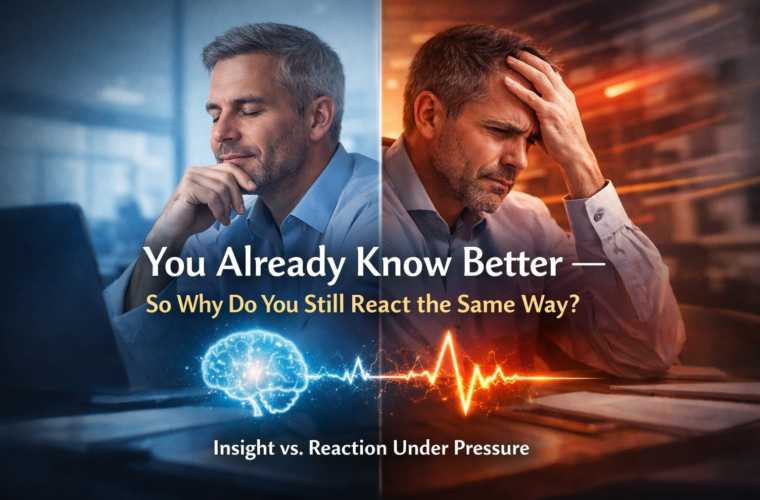
This gap is often interpreted as a lack of discipline or follow-through. In reality, it points to something more fundamental: the system simply does not have enough available capacity in those moments to respond differently.
What “capacity” actually refers to
Capacity is the ability of your nervous system to stay open, responsive, and choice-enabled when demands increase. It determines whether, in moments of urgency or uncertainty, you can still access perspective, emotional range, and deliberate action — or whether your responses narrow and become automatic.
When capacity is sufficient, you can hold complexity without forcing outcomes or losing connection. When capacity is stretched or depleted, the system shifts into efficiency mode. It prioritizes speed, control, and output, not because that is always the best leadership response, but because it is what remains available.
This is why insight alone does not reliably change behavior. The nervous system may understand what would be wiser, but lack the physiological room to execute it in real time.
“High functioning” is not the same as having high capacity
Many leaders are described as “high functioning.” They show up, deliver, and keep things moving even in demanding environments. They are dependable, capable, and resilient in the eyes of others.
Physiologically, high functioning often means the nervous system is very skilled at staying activated. Cortisol and adrenaline provide focus, urgency, and drive. For a while, this works extremely well. Over time, however, sustained activation starts to feel like baseline rather than a temporary response.
From the outside, this looks like strength and reliability. Internally, it often comes with subtle but cumulative costs. Sleep becomes lighter, recovery takes longer, tension accumulates, and emotional bandwidth narrows. Connection with others requires more effort, not because the leader cares less, but because the system is operating in vigilance rather than stability.
Why pressure exposes limits rather than creating problems
Pressure does not create unhelpful leadership behavior. It exposes the limits of what the system can hold.
When demands rise, leadership behavior is guided less by values and more by capacity. The nervous system defaults to what has historically kept things under control: tightening focus, pushing through, taking over, or overriding internal signals.
This is why leaders so often say, “I know better, and I still do it.” The issue is not a lack of awareness. It is that the system does not have enough room, in that moment, to support a different response.
The cost of prolonged activation
Being highly effective at staying activated does not mean you are leading at your best over time. It means you are operating in a mode optimized for execution and performance, not for sustained clarity, adaptability, or relational attunement.
Leadership at senior levels requires more than output. It requires judgment under uncertainty, emotional range, and the ability to stay oriented when things do not go according to plan. These capacities depend on a system that is not constantly braced for threat.
When activation becomes chronic, the body eventually intervenes. Fatigue, anxiety, irritability, pain, or a sudden drop in resilience are not random failures. They are signals that the system has been carrying more than it was designed to sustain without recovery.
The body does not negotiate indefinitely. It compensates — until it cannot.
Expanding capacity changes behavior without force
Lasting change does not come from trying harder or applying more discipline. It comes from expanding inner capacity so that insight, values, and intention are accessible under pressure, not just in hindsight.
As capacity increases, reactions slow naturally. Perspective widens. Decisions feel clearer. Leadership becomes less about holding yourself together and more about responding with precision and range.
Nothing about your role needs to change, and nothing about your ambition needs to soften. What changes is how much your system can hold without defaulting to survival-based strategies.
If this resonates, it may be a sign that you are not failing as a leader, but that you have been operating at the edge of your capacity for too long. If you’d like to explore what this looks like in your specific context and how capacity can be rebuilt in a way that supports high-level leadership, you’re welcome to contact me and continue the conversation.