

Leadership is not only expressed through decisions and behavior. It is experienced internally — especially under pressure.
Leadership is not only expressed through decisions and behavior.
It is experienced internally — especially under pressure.
What this is
The Executive Energy & Capacity Assessment is built on the Energy Leadership Index™ (ELI), a research-backed psychometric instrument developed by the Institute for Professional Excellence in Coaching (iPEC). It measures how your energetic orientation and perception influence leadership behaviour — and what those patterns reveal about your inner capacity, particularly under pressure.
This is not a personality test. It is an assessment of how you experience and respond to the demands of leadership — particularly when pressure increases.Capacity is the structural space from which decisions are made, authority is exercised, and complexity is held. When it expands, leadership changes — not because you work differently, but because you are operating from a wider internal field.
Most leaders are not surprised by the results themselves. They are surprised by how precisely the Assessment reflects the internal effort they already know they are carrying — and by the structural clarity it provides about where that effort is concentrated.
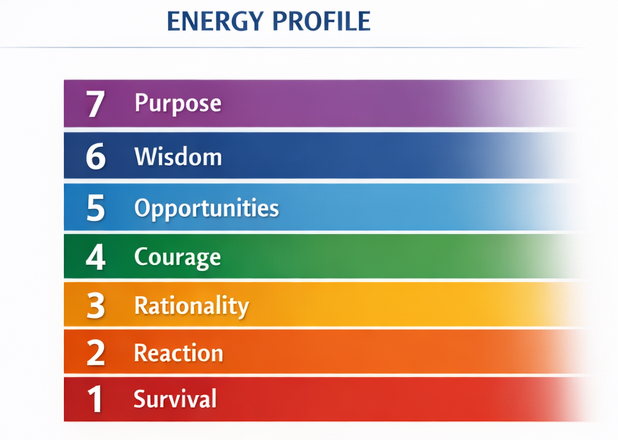
The Assessment establishes two specific data points that anchor the entire CDL engagement arc. The first is your Average Resonating Level — the energetic orientation from which you typically engage with leadership and its demands. The second is your Stress ARL — how that orientation shifts when pressure rises. The gap between the two is the primary quantitative indicator of Internal Cost: the unseen effort required to maintain performance under load.
Your average energetic orientation and how you typically perceive leadership situations
Your energy profile across the seven levels — and which collapse under stress
Your stress response profile: how perception and decision-making shift when pressure increases
The patterns shaping authority, communication, and leadership presence under load
The debrief
The Assessment provides data. The value for your capacity profile emerges in interpretation. In a structured 90-minute confidential debrief, we examine what your energy and stress profile reveals about how your leadership is being carried — where it is stable, where it contracts under pressure, and where the internal cost is concentrated.
The debrief covers what your energy levels reveal about how responsibility is held, how your perception shifts under stress, where internal effort increases to maintain effectiveness, and which patterns support your leadership and which may narrow your capacity when demands rise.
We do not treat the results as labels. We use them as a structured mirror — connecting your energy profile to your lived leadership experience through careful dialogue.
This is where the Capacity-Driven Leadership method begins. The debrief also includes a structured capacity conversation and the Engagement Intention Statement — your articulation of what you want leadership to feel like, which becomes the reference point at every subsequent formal touchpoint.
What happens after
The Assessment is the entry point for all three Capacity-Driven Leadership programmes and is also available as a standalone engagement. For leaders who want to establish a precise baseline before committing to a programme, completing the Assessment first is the appropriate starting point — the data it produces makes any subsequent programme choice significantly more precise.
Where a leader continues into a CDL programme, the E2C baseline carries forward across the full engagement arc. It is not repeated unless a second comparative Assessment is conducted at close — which occurs in the Sustained Capacity Programme as part of the formal evidence chain.
Capacity Foundation
→
Capacity Expansion
→
Sustained Capacity Programme
→
Who this is for
The Assessment is designed for senior and executive leaders who carry significant responsibility, operate in complex environments, and value structural precision over quick fixes. It is particularly relevant for leaders who have already invested in development and have found that understanding the pattern at the behavioural level has not been sufficient to change what happens internally under pressure.
It is also useful for leaders who want to establish a clear, evidenced baseline before committing to a longer capacity development arc — and for organisations that require structured documentation of leadership capacity at entry and close.
Approximately 20–30 minutes. Completed in your own time before the debrief session.
A comprehensive individual report produced from your Assessment results.
Confidential. Structured interpretation of your results in the context of your specific leadership situation.
Agreed in writing at the close of the debrief. Becomes the reference point for any subsequent CDL programme.
Available standalone or as programme entry
Can be completed as a standalone engagement. Carries forward as the baseline if a CDL programme follows.