The internet is full these days with well meant tips and advice on nervous system regulation. In fact, the flood of information is so much that understanding nervous system regulation can feel intimidating because it sounds like something you’re supposed to “do” correctly—breathe a certain way, think a certain thought, follow a certain routine.
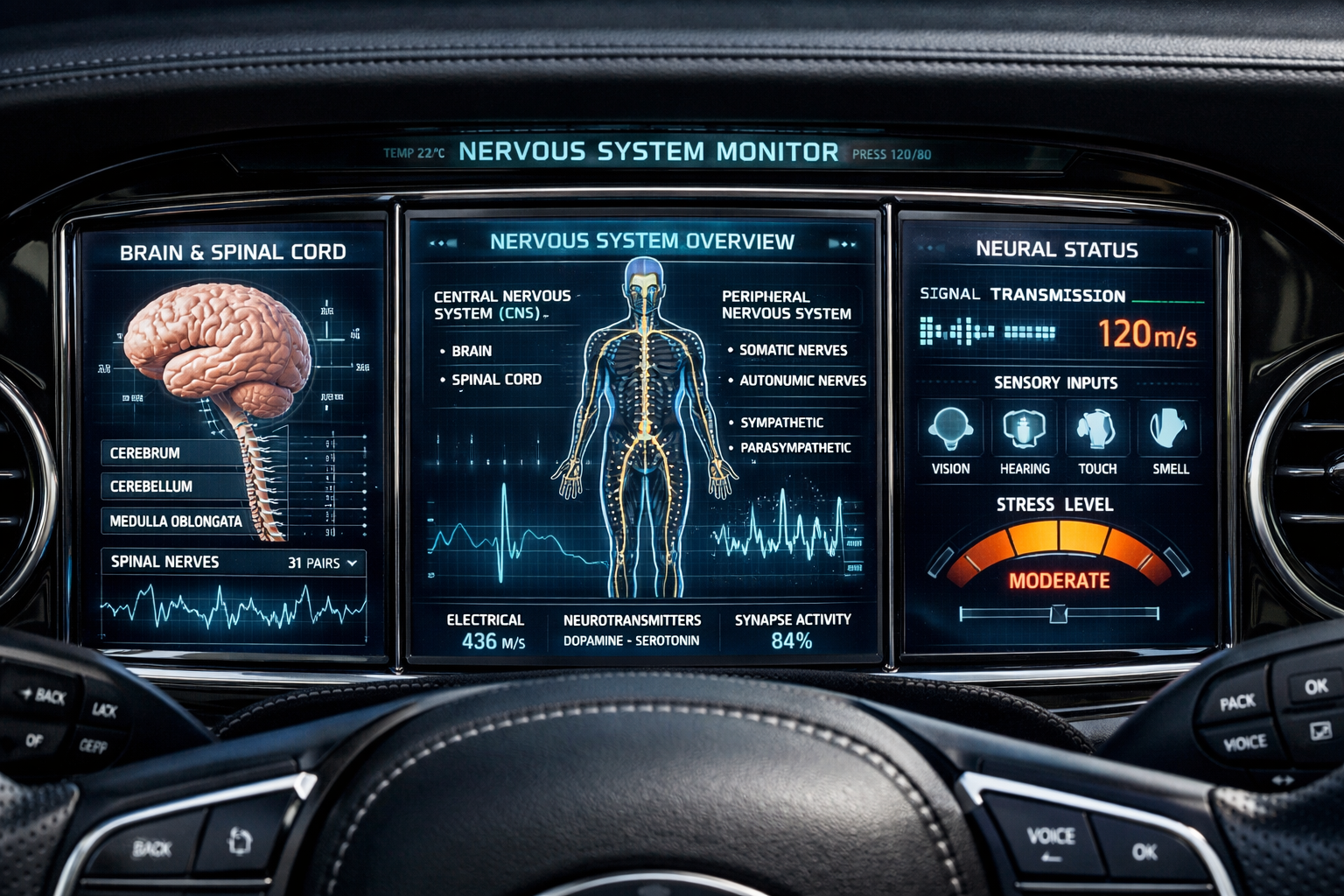
A more helpful starting point is simpler: treat your nervous system like a dashboard. Not as a moral scorecard and not as a problem to fix on sight, but as information. When you learn what your signals mean, you’re less likely to be surprised by your reactions and more likely to respond with choice instead of urgency.
Why a ‘Dashboard’ View of Regulation Helps
Thinking in terms of a dashboard shifts nervous system regulation from an abstract idea into something practical and familiar. A dashboard doesn’t tell you you’re “good” or “bad”; it tells you what’s happening. If the fuel light turns on, it doesn’t mean you failed—it means you have useful information. In the same way, a racing heart, shallow breathing, a clenched jaw, or a foggy mind aren’t necessarily “wrong.” They can be read as indicators of your system trying to manage demand, stress, uncertainty, or even excitement.
This lens also makes room for the fact that “dysregulation” isn’t rare or dramatic—it’s human. Nervous system dysregulation can show up as feeling stuck in high alert (restless, irritable, wired-but-tired) or stuck in shutdown (numb, unmotivated, spaced out, heavy). It can happen after big events like grief or trauma, but it also happens after small, repeated pressures: chronic overwork, poor sleep, relational tension, financial strain, sensory overload. The dashboard model normalizes this without minimizing it.
A dashboard view helps because it reduces the pressure to perform regulation perfectly. Many people get stuck thinking, “If I’m regulated, I should always feel calm.” But a car that never changes RPM would be stalled. A healthy nervous system shifts states throughout the day: mobilizing for meetings, softening during rest, becoming alert when something needs attention. Regulation isn’t the absence of activation; it’s the ability to move through states and return, more or less, when the moment passes.
Finally, dashboards are about prevention and context, not panic. If you know your engine tends to run hot on long hills, you plan differently; you don’t shame the car for heating up. Similarly, if you notice that social events drain you, or that conflict makes you go blank, or that multitasking spikes your anxiety, that knowledge is power. The goal is not to label yourself, but to understand your patterns so your life stops feeling like a series of mysterious emotional weather events.
Reading Your Signals Without Fixing Anything Yet
One of the most underrated skills in nervous system work is simply noticing—without immediately intervening. Many of us were taught to override signals: push through fatigue, ignore hunger, suppress tears, “be fine.” Over time, that can make body signals feel either too loud (overwhelming) or too quiet (hard to sense). A dashboard approach invites you to rebuild signal literacy: “What am I noticing, and what might it be telling me?” No immediate action required.
Start with neutral observations. Where is there tension—jaw, shoulders, stomach? How is your breathing—deep, shallow, paused? What’s your energy like—racing, steady, depleted? What’s your attention doing—scanning for problems, fixating, drifting? What’s your social orientation—seeking closeness, needing space, feeling guarded? These aren’t tests to pass. They’re data points that can reveal whether your system is leaning toward activation (fight/flight) or conservation (freeze/shutdown), or whether it’s relatively settled.
It also helps to notice timing and triggers rather than judging the signal itself. Does your body rev up before you check email? Do you crash after being around a certain person? Do you get foggy when you have to make a decision quickly? Patterns matter because they show you that your reactions are often predictable responses to context, not personal flaws. Dysregulation frequently makes people feel “random” or “broken,” but pattern recognition restores coherence: “Oh, this is what my system does here.”
And you can practice reading signals the way you’d check the weather: not to control it, but to dress appropriately. If you learn that your nervous system gets “stormy” after back-to-back commitments, you might not change anything immediately. You might just name it: “That makes sense.” This is a form of regulation by itself—because naming reduces threat. When the mind understands what’s happening, the body often stops escalating as much.
Like Knowing Car Gauges: Awareness Before Action
Most people don’t stare at their car dashboard all day, but they’re glad it exists. You don’t take your car to the mechanic every time the engine temperature rises slightly in traffic. You watch it. You note the context. You decide if it’s within normal range or if it’s trending toward a problem. Nervous system awareness works the same way: you’re learning what “normal ranges” feel like for you, and what patterns suggest you might need a change—now or later.
Another everyday analogy is personal finance. It’s useful to understand your bank balance and spending habits even if you’re not trying to optimize your budget every day. You don’t need to become an expert investor to benefit from knowing where your money goes. Similarly, you don’t need to turn nervous system regulation into a new project. Simply recognizing, “I’m running low today,” can prevent you from committing to something you’ll resent, picking a fight, or interpreting fatigue as failure.
Awareness before action also protects you from overcorrecting. When people learn about regulation, they sometimes try to “fix” every uncomfortable feeling—like hitting the brakes whenever the RPM climbs. But activation isn’t always danger; it can be enthusiasm, focus, anticipation. Low energy isn’t always shutdown; it can be genuine need for rest. A dashboard mindset helps you distinguish between “My system is responding normally” and “My system is stuck.” That discernment is what makes later tools—breathing practices, movement, boundaries, therapy—more effective.
Over time, the biggest payoff is choice. When you can read your internal gauges, you’re less likely to be hijacked by them. You may still feel anxious, tense, or flat sometimes, but those states become understandable experiences rather than identities. You start to recognize early signs (the first notch upward on the stress gauge) instead of only noticing when you’re already at the redline. And that gentle, consistent awareness often becomes the foundation for regulation—without forcing you to “do” anything dramatic.
Nervous system regulation doesn’t have to begin with techniques; it can begin with comprehension. A dashboard view reframes dysregulation as information rather than inadequacy, and it invites you to become a careful reader of your own signals. Like knowing the gauges on a car—or keeping an eye on your finances—this understanding is useful even when you don’t take immediate action. Awareness builds familiarity, familiarity builds steadiness, and steadiness makes it easier to recognize what you need when you actually need it.