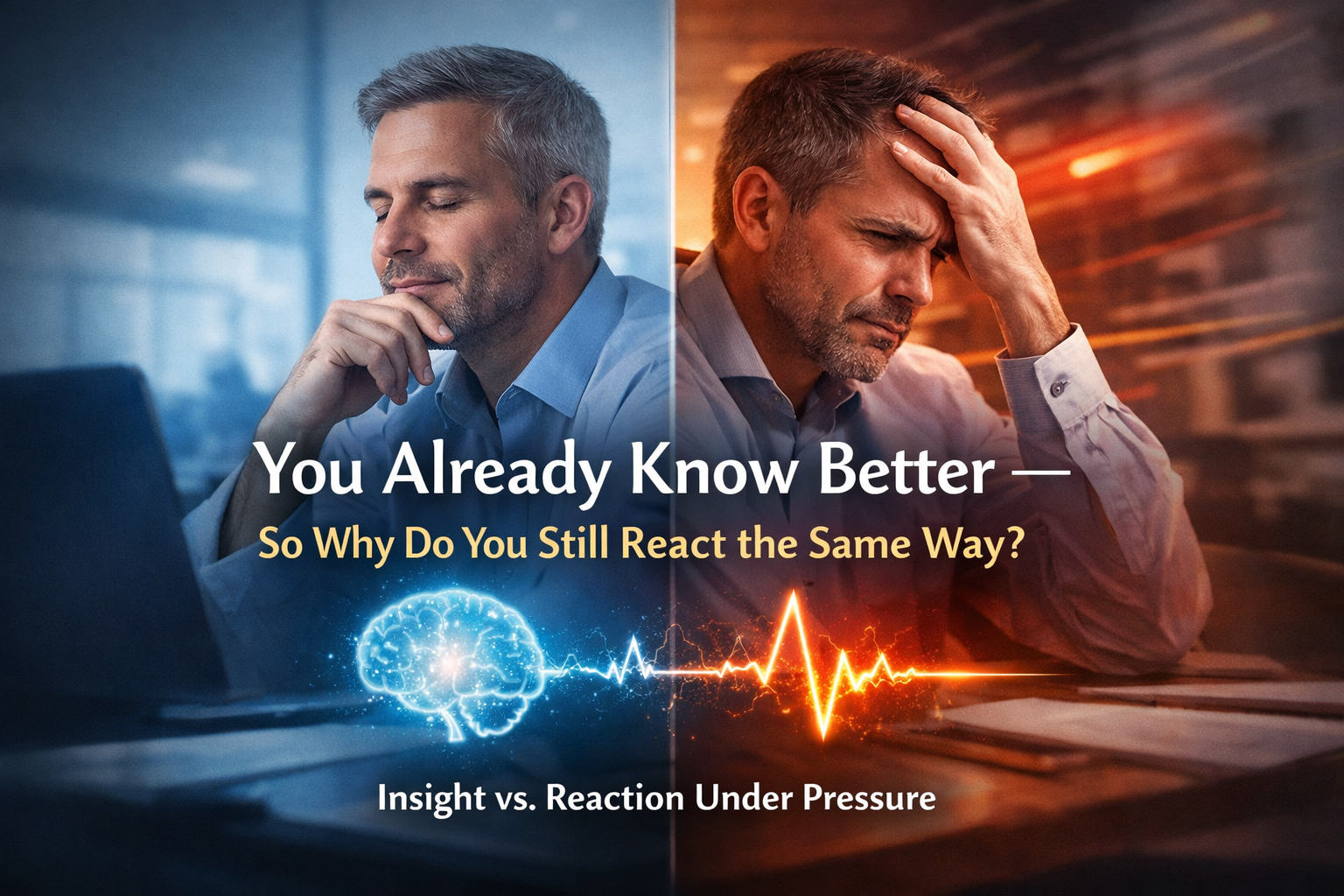
Most of the people I work with in Pain Reprocessing Coaching are not lacking insight.
They have read or heard about neuroplastic pain. They understand that the brain can generate real symptoms in the absence of ongoing tissue damage. They know that fear, attention, and stress can amplify pain pathways. Intellectually, it makes sense.
And yet, when the pain flares…
when anxiety spikes…
when the body tightens without warning…
they still find themselves reacting in ways that don’t fully align with what they “know.”
They brace.
They scan.
They try to fix.
They push through.
Or they withdraw and feel defeated.
This gap is often interpreted as, “Maybe I don’t believe it enough,” or “Maybe I’m not doing the work properly.”
In reality, it usually points to something more fundamental: the nervous system simply does not have enough available capacity in that moment to respond differently.
What capacity actually refers to
Capacity is the ability of your nervous system to stay open and regulated when sensations, stress, or uncertainty increase.
It determines whether, when a symptom appears, you can stay curious and grounded — or whether your system automatically shifts into protection.
When capacity is sufficient, you can notice a pain signal and think:
“This is uncomfortable, but I am safe.”
When capacity is stretched or depleted, the system prioritizes protection. It increases vigilance. Muscles tighten. Breathing becomes shallow. Attention narrows around the symptom.
This is not a character flaw.
It is a survival reflex.
And this is why insight alone does not reliably change symptoms. Your brain may understand the concept of neuroplastic pain, but if your nervous system does not feel safe, it will continue to generate protective responses.
High functioning is not the same as high capacity
Many of my clients are high functioning.
They go to work.
They care for their families.
They meet responsibilities.
They push through fatigue, discomfort, and anxiety.
From the outside, they look strong and resilient.
Physiologically, high functioning often means the nervous system is very skilled at staying activated. Stress hormones like cortisol and adrenaline keep you moving. For a while, this works.
Over time, however, sustained activation starts to feel normal. Tight shoulders, a clenched jaw, restless sleep, a constant background hum of tension — it becomes the baseline.
The body is not broken.
It is overprotective.
Why symptoms intensify under pressure
Symptoms rarely appear out of nowhere. They intensify when the system feels overloaded, uncertain, or under sustained strain.
Pressure does not create weakness.
It exposes the limits of what your system can currently hold.
When demands rise — at work, in relationships, internally — the brain looks for ways to regain control. If it has learned that pain or anxiety reliably captures attention and slows you down, it may use those pathways again.
Not to harm you.
But to protect you.
This is why so many people say:
“I know this is probably stress-related, but my body reacts anyway.”
Yes. Because this is not primarily an intellectual process.
It is a learned nervous system pattern.
The cost of prolonged activation
Being good at pushing through does not mean your system is thriving.
Chronic activation narrows your emotional range. It reduces recovery. It makes everything require slightly more effort than it should. It can show up as:
• persistent pain
• waves of anxiety
• fatigue that doesn’t fully resolve
• irritability or emotional fragility
• new symptoms that seem to “move”
These are not random failures.
They are signs that your system has been operating at the edge of its capacity for too long.
The body does not negotiate indefinitely. It compensates — until it asks for a different approach.
How PRT works with capacity
Pain Reprocessing Therapy is not about convincing yourself that nothing is wrong.
It is about helping your nervous system experience safety again.
Through somatic tracking, gentle exposure, and a different relationship to sensation, the brain begins to update. It learns that these signals are not dangerous. Over time, protective activation decreases.
Capacity expands.
As capacity increases:
reactions slow naturally,
fear reduces,
the intensity of symptoms often softens,
and you gain more choice in how you respond.
You are not forcing your body to behave differently.
You are teaching it that it no longer needs to stay on guard.
If this resonates, it may not mean that you are doing something wrong. It may simply mean that your system has been carrying more than it can sustainably hold.
Recovery is not about trying harder.
It is about creating enough inner safety for your brain to update.
And that process is both learnable and possible.