The internet is full of well-meant advice about nervous system regulation.
Breathe this way. Think that way. Follow this routine. Download that app.
For leaders, this can quickly turn into another performance standard:
“Am I regulating correctly?”
But regulation is not a leadership KPI. It is not something to perfect.
A more useful starting point — especially in leadership — is this:
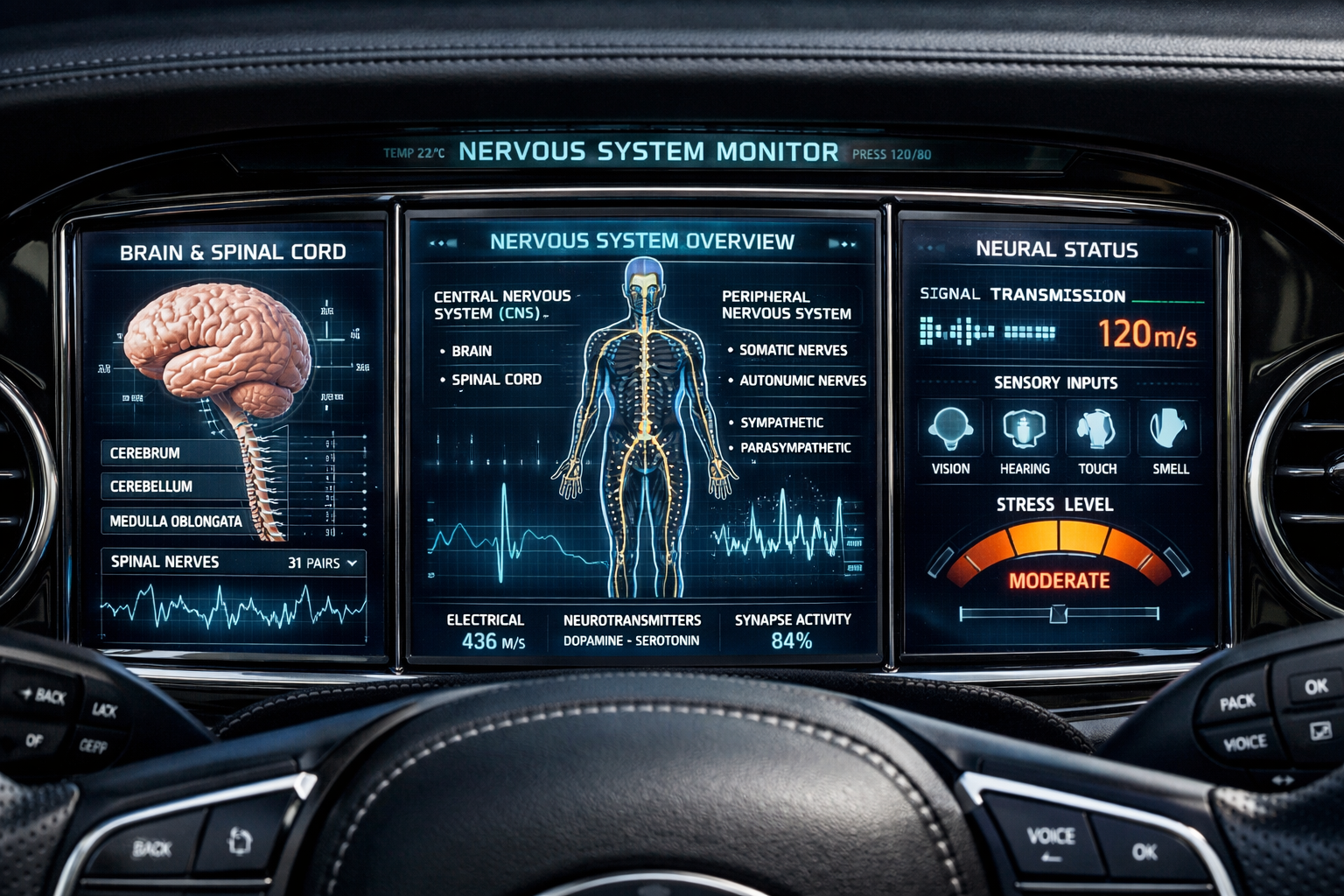
Treat your nervous system like a dashboard.
Not as a moral scorecard.
Not as a weakness.
Not as something to fix at the first sign of activation.
But as information.
When you understand your internal signals, you are less likely to be surprised by your reactions — and more likely to respond with choice rather than urgency.
Why a Dashboard View Matters in Leadership
Leadership is not emotionally neutral work.
You make decisions with incomplete information.
You carry responsibility for outcomes you cannot fully control.
You hold tension between stakeholders, timelines, and expectations.
In that environment, your nervous system is constantly adjusting.
A dashboard does not tell you whether you are a “good” or “bad” leader. It tells you what is happening inside your system.
Racing heart before a board meeting.
Tight jaw during conflict.
Mental fog late in the day.
Irritability when priorities shift.
These are not leadership failures.
They are internal indicators that demand is increasing.
Just as a fuel light does not mean you have failed as a driver, activation does not mean you are incapable. It means your system is mobilizing.
The problem is not activation.
The problem is misreading it.
When leaders interpret activation as danger or inadequacy, they either override it (“push through”) or overcorrect it (“something is wrong with me”). Both reduce clarity.
When leaders read it as data, something shifts.
Regulation Is Flexibility, Not Calm
There is a common misconception that a regulated leader should always appear calm.
But leadership requires activation.
You need mobilization for high-stakes presentations.
You need alertness in crisis.
You need energy to move initiatives forward.
A car engine that never changes RPM is stalled.
Healthy regulation is not the absence of activation. It is the ability to move between states and return when the moment passes.
In leadership terms:
Can you mobilize without staying braced?
Can you engage conflict without carrying it into the evening?
Can you make a hard call without remaining internally contracted for days?
The dashboard model normalizes fluctuation. It reframes so-called “dysregulation” as part of being human under load — not a defect.
Reading Your Signals Before Trying to Fix Them
One of the most underdeveloped executive skills is signal literacy.
Many leaders were rewarded early in their careers for overriding internal signals:
Push through fatigue.
Ignore tension.
Deliver regardless of cost.
Over time, this creates a blind spot. Signals are either too loud (overwhelming) or barely noticeable (numbed out).
A dashboard approach restores literacy.
Instead of asking, “How do I fix this?”
You start with, “What is my system telling me?”
Where is tension accumulating?
Is my attention widening or narrowing?
Am I scanning for problems or thinking strategically?
Is my tone tightening?
Is my decision speed accelerating?
These are not weaknesses. They are data points about capacity.
Leadership behavior is often shaped less by values and more by available capacity in the moment. When your system is in high activation, perspective narrows. When it leans toward shutdown, initiative drops.
Pattern recognition restores coherence.
You begin to see:
“I tighten before stakeholder reviews.”
“I get foggy when I lack clarity.”
“I overcommit when I feel pressure to prove.”
Reactions stop feeling random. They become predictable responses to context.
And predictability creates leverage.
Awareness Before Intervention
You do not stare at your car dashboard all day. But you are glad it exists.
If the temperature rises slightly in traffic, you observe. You consider context. You do not panic.
Leadership works the same way.
If you know that back-to-back decisions drain you, you plan recovery differently.
If you know that conflict triggers contraction, you prepare more consciously.
If you know that ambiguity spikes urgency, you widen perspective before acting.
This is not self-optimization.
It is structural leadership maturity.
Another useful analogy is financial awareness. You do not need to optimize your portfolio daily to benefit from knowing your balance. Simply recognizing, “I’m running low today,” might prevent you from making a reactive decision, escalating unnecessarily, or committing to something misaligned.
Awareness before action also protects you from overcorrection.
Activation is not always threat. It can be focus, ambition, engagement.
Low energy is not always dysfunction. It can be genuine need for recovery.
The skill is discernment:
Is my system responding appropriately to context?
Or is it stuck?
Choice Is the Real Outcome
The greatest benefit of a dashboard mindset is not calm. It is choice.
When you can read your internal gauges, you are less likely to be hijacked by them.
You may still feel urgency.
You may still feel tension.
You may still feel fatigue.
But those states become experiences — not identities.
You start noticing the first rise in the stress gauge rather than realizing you have been at redline for weeks. That early awareness expands leadership capacity: the space between stimulus and response.
Nervous system regulation in leadership does not have to begin with techniques.
It can begin with comprehension.
A dashboard view reframes internal activation as information rather than inadequacy. It invites you to understand your patterns so leadership stops feeling like a series of unpredictable emotional weather systems.
Awareness builds familiarity.
Familiarity builds steadiness.
Steadiness expands capacity.
And capacity — not force — is what allows leaders to respond with precision when it matters most.